Industries
NitPro Composites serves diverse industries with high-performance carbon fiber sheets, plates, rods, and custom composite solutions. From aerospace and automotive to medical, robotics, marine, and industrial manufacturing, we deliver precision-engineered materials.
Composites solution for Defence: Where Performance Specifications Are Not Negotiable
Defence programmes don’t get second chances. A UAV that loses structural integrity mid-mission, a vehicle panel that fails under blast loading, a soldier system that adds unnecessary weight at the wrong moment- these aren’t engineering inconveniences. They’re operational failures with consequences that go beyond the technical.
Carbon fiber reinforced polymer (CFRP) has become a material of choice across defence platforms precisely because it doesn’t require trade-offs between strength and weight. It’s not a compromise material. In the right application, it outperforms metals on the metrics that matter most: specific strength, specific stiffness, fatigue life, while dramatically reducing mass.
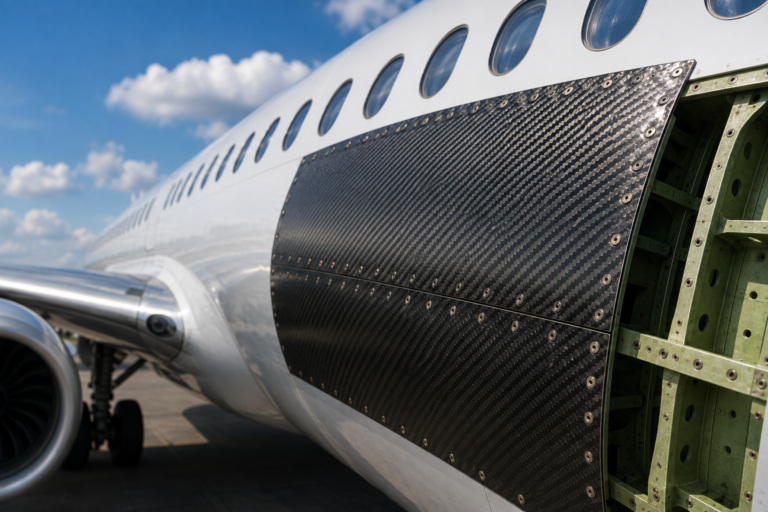
Carbon Fiber Composites for Aerospace — Built Where Weight is Never a Compromise
Aerospace has always had a straightforward problem. You need structures that are strong enough to survive extreme loading, stiff enough to hold their shape under pressure, and light enough that the vehicle can actually fly efficiently. For decades, engineers made do with aluminium alloys and titanium. Good materials, both of them. But as aircraft got more complex and UAVs went from military curiosity to mainstream platform, the industry needed something better.
Carbon fiber is something better. Not because it’s new or exciting, it’s been used in aerospace since the 1970s, but because the performance gap over metals is real, measurable, and significant. CFRP structural parts are typically 40 to 60 percent lighter than aluminium equivalents. The tensile strength? Higher. The fatigue resistance? Much better. And unlike aluminium, carbon fiber doesn’t corrode.

Structural Carbon Fiber for Space — When There's No Second Chance to Get It Right
There is no more unforgiving environment for a structural material than space. The launch itself subjects everything to vibration loads that would destroy a poorly designed part within seconds. Then, once in orbit, the temperature swings between positive and negative extremes — sometimes more than 200°C — every time the spacecraft passes from sunlight to shadow. And any structural change, any dimensional shift, any relaxation of tolerances, directly affects whether the mission works.
This is why carbon fiber has been central to spacecraft design for decades. Not because it’s lighter than aluminium (though it is, significantly). Not just because it’s stiffer for the same weight (though that matters too). Mainly because when you design a carbon fiber composite structure with the right fiber orientation and the right matrix, you can get near-zero CTE — meaning the structure barely changes dimensions across that brutal temperature cycle. For an optical instrument, an antenna reflector, or a precisely positioned sensor, that stability is the whole point.
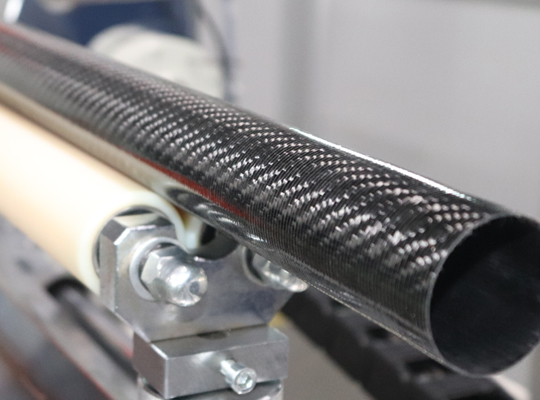
Carbon Fiber for Industrial Applications — When Your Machines Need to Move Faster and Last Longer
Most industrial engineers come to carbon fiber the same way: they’ve hit a ceiling with metal. The robot arm is as fast as the motor can drive it, but the arm itself is too heavy to go faster without damaging the gearbox. The roller on the production line runs fine at 200 metres per minute but deflects at 350. The telescopic pole that works perfectly at 4 metres starts to oscillate badly at 6.
Carbon fiber doesn’t solve every problem. But in situations where the limiting factor is the mass or the stiffness of a moving or loaded component, which, in industrial machinery, is more often than people expect, it genuinely changes what’s possible.
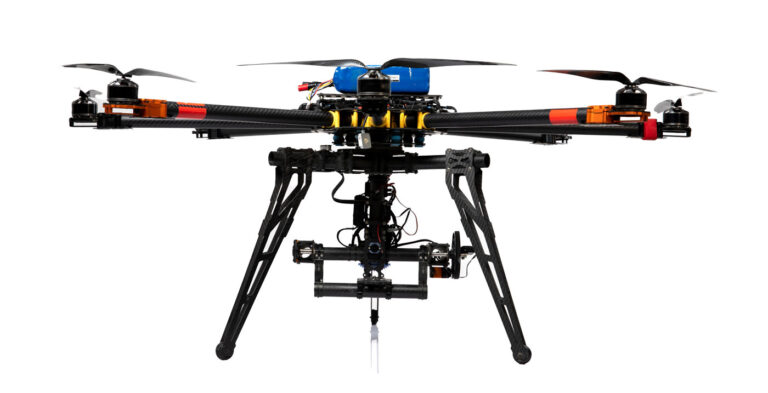
Carbon Fiber Composites for UAVs and Drones - Every Gram You Remove Is Payload, Endurance, or Both
UAV design is a weight optimisation problem. The airframe needs to be stiff enough to hold the motor arms true under thrust, strong enough to survive operational loads and the occasional hard landing, and light enough that the flight controller has something worth flying in the first place.
Aluminium and fibreglass both work up to a point. But when you’re trying to push endurance beyond forty minutes, carry a thermal or LiDAR payload on a platform that fits in a backpack, or produce an industrial drone that operators will fly dozens of cycles a day, the material choice stops being a secondary consideration. It becomes central to whether the platform is competitive.
Carbon Fiber Composites for Medical Applications — Precision, Biocompatibility, and the Weight That Patients Actually Notice
Medical engineering has a constraint that most industries don’t: the end user of the device is often a person who will wear it, carry it, or have it operate on or near their body. That changes the design calculus in ways that go beyond structural performance. An orthopaedic brace that weighs too much causes patient non-compliance. A prosthetic limb that doesn’t match the stiffness of natural tissue transfers load incorrectly. A surgical robot arm that flexes under load introduces positional error at the tool tip. An imaging table that absorbs X-rays compromises diagnostic quality. These are engineering problems with direct clinical consequences.
Carbon fiber composites address each of these. The material is light, stiff, radiolucent, chemically inert, and capable of being formed into precise geometries. It is not a universal solution, but in the right medical application, it performs in ways that no comparable material can match.


Carbon Fiber Composites for Energy & Power Infrastructure - Strength That Doesn't Add Load
Power infrastructure is built to last decades under continuous mechanical and environmental stress. Wind turbine blades flex through millions of load cycles. Transmission lines sag under their own weight across every span. Structural supports carry static and dynamic loads through decades of weather exposure. In every one of these cases, the material carrying the load has to be strong enough for the duty cycle and light enough that its own weight doesn’t work against the design.
This is where carbon fiber composites have become the material of choice across serious energy infrastructure programmes. High specific stiffness reduces deflection without adding mass. High fatigue resistance means components hold up across a service life measured in decades rather than years. And resistance to corrosion means field performance doesn’t degrade the way metal components eventually do in exposed, high-humidity, or coastal environments.
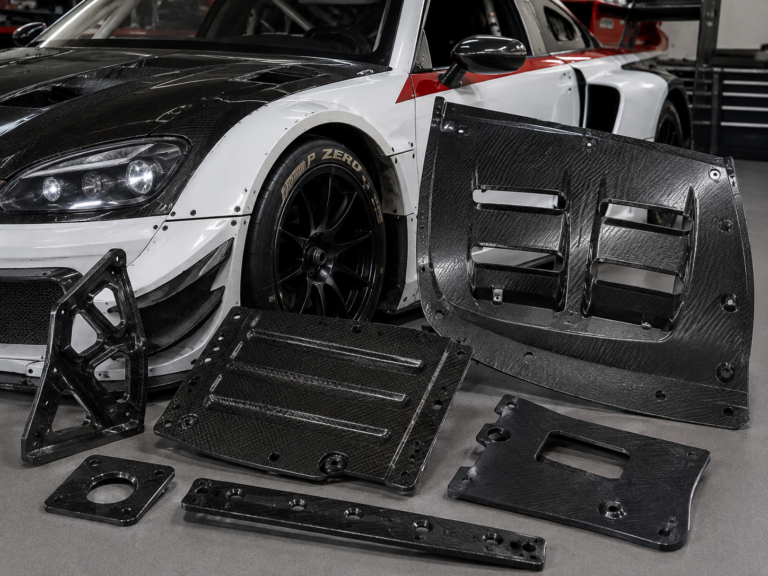
Carbon Fiber Composites for Automotive & Electric Mobility - Weight Is the Whole Equation
Every automotive programme is fighting the same battle. Combustion platforms need to hit emissions targets. Electric platforms need to stretch range out of a battery pack that already accounts for a third of the vehicle’s mass. Motorsport teams need lap time. In every case, the answer runs through the same variable: mass.
Steel and aluminium have carried the industry this far, but both run into limits when a programme needs to cut structural weight without giving up stiffness or crash performance. Carbon fiber composites solve that trade-off directly. Higher specific stiffness than steel, higher specific strength than aluminium, and the ability to tailor fiber orientation so material sits exactly where the load path needs it, not spread evenly where it doesn’t.