
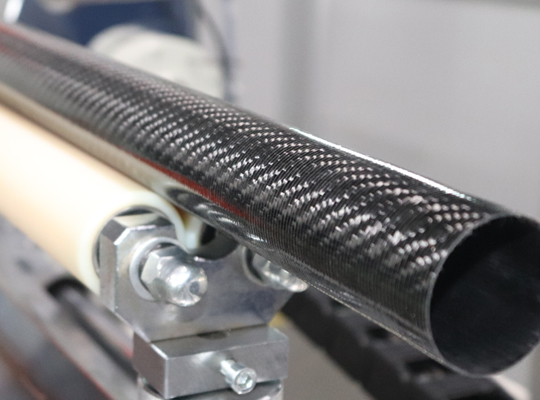
1. Carbon Fiber Prepreg Roll Wrapping
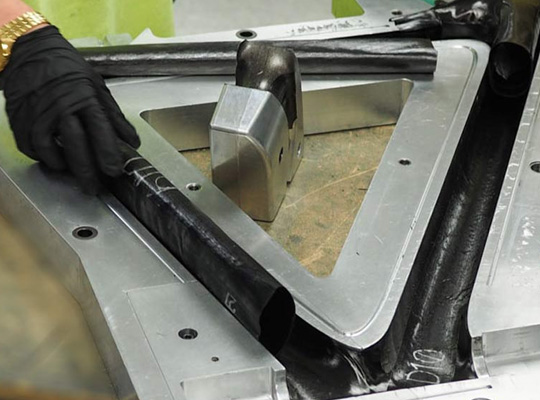
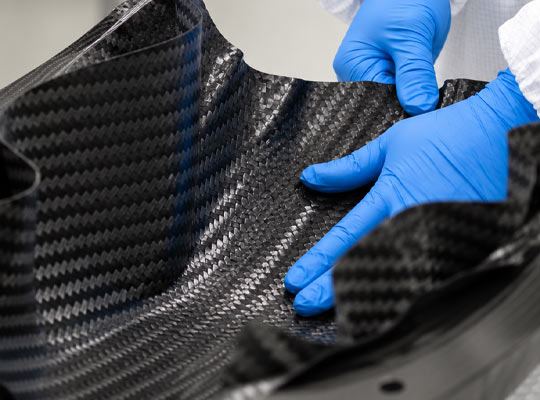
NitPro Composites manufactures carbon fiber prepreg tubes using German-engineered automatic multi-stage high-precision roll wrapping machines. This process involves laying up multiple piles of multi-directional and unidirectional prepreg materials — composite sheets in which carbon fibers are pre-impregnated with a precise ratio of epoxy resin — around a mandrel before curing under controlled heat and pressure.
The result is a carbon fiber tube with an exceptional strength-to-weight ratio, dimensional consistency, and excellent surface quality. Because the resin content is pre-controlled in prepreg material, roll-wrapped tubes achieve higher fiber volume fractions and more repeatable mechanical properties than hand lay-up alternatives.
We manufacture prepreg roll-wrapped carbon fiber tubes from 6 mm to 120 mm outer diameter, in custom wall thicknesses, and up to 2 metres in length. All tubes are available in multiple surface finishes:
- Cello-wrapped gloss finish
- Smooth ground gloss finish
- Smooth ground matte finish
Weave pattern options include twill weave, plain weave, and unidirectional weave. Custom outer diameter, inner diameter, wall thickness, and length combinations are available on request.
Applications:
- Drone & UAV frames
- Aerospace tubes
- Robotic arms
- Medical imaging
- Camera rigs
- Defence antenna masts
- Wind energy structures
- Automotive parts
2. Carbon Fiber Pultrusion Process
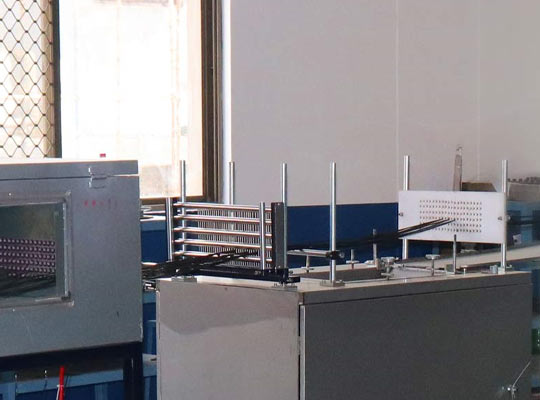
Pultrusion is one of the most efficient and cost-effective methods for producing continuous carbon fiber composite profiles with a constant cross-section. In the pultrusion process, continuous carbon fiber rovings and fabrics are pulled through a resin bath or injected with liquid matrix, then drawn through a heated die that shapes and cures the composite in a single continuous operation. The result is a dense, high-fiber-volume composite profile with outstanding axial strength and stiffness.
NitPro Composites operates a fully automatic, digitally controlled pultrusion line designed for consistent, high-volume production. Our production capacity of 30,000 metres per month allows us to supply both domestic and international markets at scale. For customers requiring non-standard geometries, we have in-house tooling capabilities to develop custom pultrusion dies for any constant-cross-section composite profile — round, square, rectangular, hollow, I-section, or custom form.
Pultruded carbon fiber products offer excellent mechanical properties, including high tensile strength, high modulus, and minimal moisture absorption — making them a preferred choice for structural, aerospace, and industrial applications where consistent performance across long lengths is critical.
Applications:
- Kite spars & RC models
- Construction profiles
- Industrial tubes
- Defence mast parts
- Antenna booms
- Motion control systems
3. Vacuum Infusion Process for Carbon Fiber
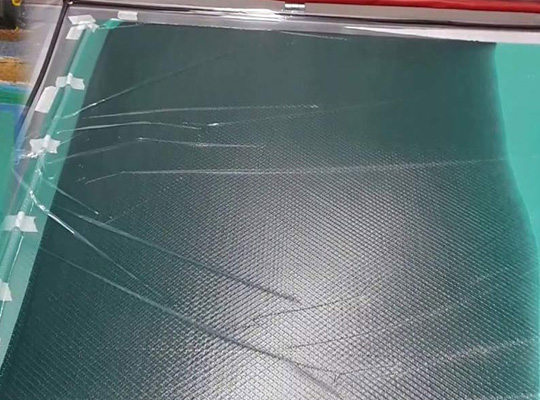
The Vacuum Infusion Process (VIP) is an advanced closed-mould manufacturing technique that uses vacuum pressure to draw liquid resin into dry fiber reinforcements laid inside a sealed mould. Unlike open hand lay-up methods, where resin is manually applied and excess is difficult to control, vacuum infusion delivers a precisely controlled fiber-to-resin ratio throughout the entire part, because the vacuum pressure both drives infusion and pulls any surplus resin into a catch pot before cure.
The outcome is a carbon fiber composite component with lower resin content, higher fiber volume fraction, reduced void content, and significantly better mechanical properties than hand lay-up alternatives. The process also reduces styrene and VOC emissions compared to open moulding, making it an environmentally preferable manufacturing route.
At NitPro Composites, we use vacuum infusion to produce carbon fiber sheets, large structural panels, laminates, and bespoke flat or curved components. The process is particularly well suited to larger parts where consistent resin distribution across a complex geometry is critical.
Applications:
- Marine craft panels
- Wind energy parts
- Automotive body panels
- Aerospace skins
- Architectural cladding
- Defence vehicle parts
4. Carbon Fiber Vacuum Bagging
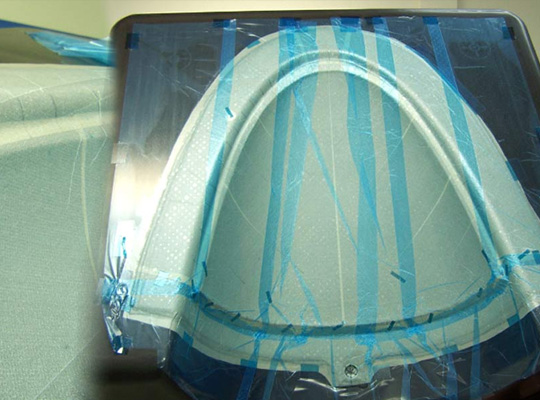
Vacuum bagging is a manufacturing process that significantly improves upon standard open hand lay-up by applying controlled vacuum pressure to consolidate the laminate and extract excess resin. In this process, dry reinforcement fabrics are laid into a mould and manually wetted with resin using rollers or brushes. A vacuum bag is then sealed over the mould and vacuum is applied, drawing excess resin out of the laminate and compressing the fiber plies together during cure.
The improvement over unreinforced hand lay-up is substantial. Vacuum bagging produces a higher fiber-to-resin ratio, reduces porosity, improves interlaminar adhesion, and results in a lighter and structurally stronger finished component. While it does not achieve the fiber volume fractions of prepreg or vacuum infusion, vacuum bagging remains a highly flexible and cost-effective process for low-to-medium volume parts, complex geometries, and prototype development.
NitPro Composites operates vacuum bagging facilities for both room-temperature cure and elevated-temperature cure applications, allowing us to process a wide range of epoxy, vinylester, and specialty resin systems. This capability makes us well suited to prototype development, short production runs, and applications where tooling investment for more automated processes is not yet justified.
Applications:
- Prototype parts
- Short-run components
- Tooling & jigs
- Sports equipment
- Marine structures
- Industrial enclosures
5. Carbon Fiber Bladder Moulding
Bladder moulding is the preferred manufacturing process for producing complex hollow carbon fiber structures that cannot be made by roll wrapping or pultrusion. The process works by wrapping prepreg carbon fiber material around an inflatable bladder, inserting the assembly into a matched female cavity mould, then applying both heat and internal air pressure simultaneously. The air pressure inflates the bladder outward, pressing the carbon fiber laminate firmly against the mould cavity walls as it cures. After cure, the bladder is deflated and removed, leaving a lightweight, strong, and dimensionally precise hollow component.
This process enables the production of carbon fiber parts with complex internal geometries, tight external tolerances, and excellent surface quality on both inner and outer surfaces — capabilities that other composite processes cannot easily replicate.
NitPro Composites has extensive hands-on experience with bladder moulding and manufactures a range of products using this technology, including carbon fiber badminton rackets and other high-performance sporting goods. Our toolroom capability allows us to develop custom bladder moulding tooling for new product programmes.
Applications:
- Badminton rackets
- Bicycle frames
- Aerospace sections
- Automotive ducts
- Medical housings
- Sports equipment
6. Carbon Fiber Compression Moulding
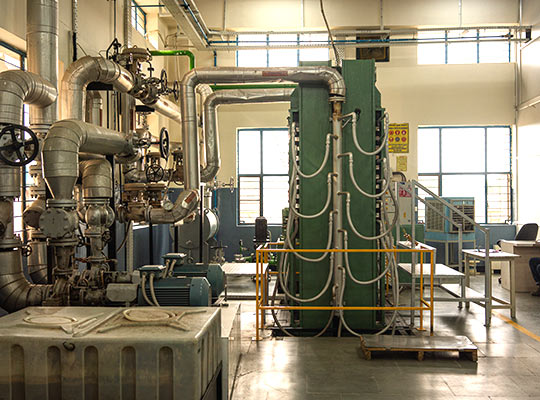
Compression moulding is NitPro's primary process for high-volume production of carbon fiber components. The process involves placing carbon fiber prepreg material — carbon fibers pre-impregnated with epoxy resin directly into a heated matched metal mould. The mould is closed under high pressure, applying both heat and compression simultaneously to cure the composite in a precisely controlled environment.
The primary advantage of compression moulding over other composite processes is cycle time. Depending on part thickness and geometry, a fully cured carbon fiber component can be produced in as little as 2 to 10 minutes per cycle. This makes compression moulding the most efficient route for producing large quantities of carbon fiber parts with consistent dimensions, surface quality, and mechanical properties at a cost per part that supports commercial-scale production.
The closed mould environment also produces excellent surface finish on both faces of the component, minimises resin loss, and ensures tight dimensional tolerances across high-volume production runs.
NitPro Composites uses compression moulding to manufacture carbon fiber laminates, CNC blanks, flat structural components, and bespoke parts for customers across aerospace, automotive, medical, and industrial sectors.
Applications:
- CNC laminate sheets
- Automotive inserts
- Aerospace interiors
- Medical orthotic plates
- Industrial wear parts
- Structural plates
7. Carbon Fiber Weaving Technology
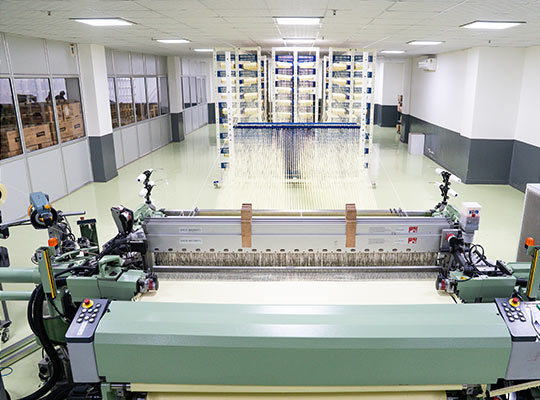
Carbon fiber weaving is the process by which continuous carbon fiber tows are interlaced on precision looms to produce woven carbon fiber fabric, one of the primary raw material forms used across composite manufacturing. The weave architecture determines the mechanical properties, drapeability, and surface aesthetics of the advanced carbon fiber textile and, ultimately, the composite parts made from it.
At NitPro Composites, we operate state-of-the-art weaving looms with meticulous tension and alignment control throughout the weaving process. Consistent fiber tension during weaving is critical for the technical textile as uneven tension produces fabric with variable mechanical properties and cosmetic defects that propagate through to the finished composite. Our controlled weaving process ensures uniform fiber distribution, consistent areal weight, and repeatable performance across every roll.
We produce carbon fiber fabric in the two most widely used weave patterns:
- Twill weave (2x2): Produces the characteristic diagonal visual pattern associated with premium carbon fiber aesthetics. Offers excellent drapeability over complex curved surfaces, making it the preferred choice for visible structural panels, automotive bodywork, and sporting goods.
- Plain weave: Interlaces fibers in a simpler over-under pattern for maximum dimensional stability and crisp, uniform surface appearance. Preferred for flat laminates, aerospace applications, and structural components where stability is prioritised over drape.
Applications:
- Prepreg manufacture
- Laminate production
- Aerospace skins
- Automotive body panels
- Sporting goods
- Marine structures
8. CNC Machining for Carbon Fiber Components
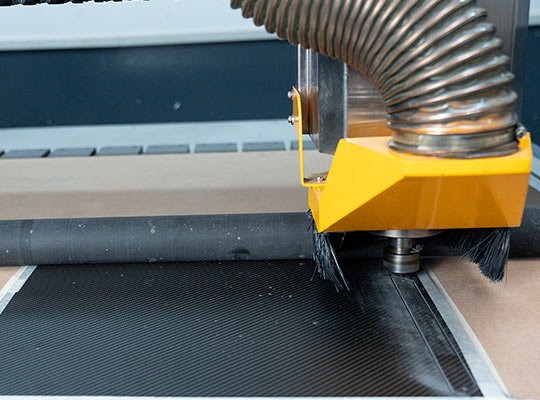
NitPro Composites operates an in-house CNC (Computer Numerical Control) machining facility for precision cutting, routing, drilling, and finishing of carbon fiber composite components. CNC machining of carbon fiber requires specialist tooling and process knowledge — carbon fiber composites are abrasive, anisotropic, and prone to delamination and fibre pull-out if cutting parameters are not correctly controlled. Our experienced technicians use purpose-designed carbide and diamond-coated tooling with optimised feeds, speeds, and dust extraction to produce clean, precise carbon fiber components without edge damage or subsurface delamination.
Our CNC tool room supports the full manufacturing workflow at NitPro. We use CNC machining to produce mould tools and jigs for other composite processes, to machine cured composite blanks into finished precision components, and to develop prototypes and short-run parts for customer evaluation.
From simple 2D cut profiles to complex 3D machined carbon fiber structures, our CNC capability handles components across a wide range of sizes and tolerances. We work from customer-supplied 2D drawings or 3D CAD files, with full dimensional inspection before dispatch.
Applications:
- Aerospace frames
- Orthopedic plates
- Drone/UAV parts
- Automotive trim
- Defence components
- Tooling plates
9. Hand Layup / Wet Layup
Hand Layup (also known as Wet Layup) is a traditional open-mould manufacturing technique in which layers of dry fiber reinforcement are placed into a mould and resin is applied manually using rollers or brushes, saturating each layer before the next is added. It is one of the most versatile and accessible composite manufacturing processes, requiring minimal tooling investment and allowing rapid changes to part geometry, ply schedule, and fiber orientation.
Unlike closed-mould processes such as vacuum infusion, hand layup gives fabricators direct control over resin application at each stage, making it well suited to low-volume production, prototyping, and parts with complex geometries or large surface areas where mould costs need to stay low. The trade-off is a higher and less consistent resin content compared to vacuum-assisted processes, since excess resin is worked out manually rather than drawn out under vacuum pressure.
At NitPro Composites, we use hand layup to produce carbon fiber components, custom panels, prototypes, and low-to-medium volume structural parts where speed, tooling cost, and design flexibility are priorities. The process is particularly well suited to one-off parts, early-stage prototypes, and applications where part geometry or production volume doesn't justify infusion or prepreg tooling.
Applications:
- Prototype and proof-of-concept parts
- Low-volume structural components
- Custom enclosures and fixtures
- Motorsport and automotive prototypes
- Architectural and design mockups
- Industrial tooling and jigs
10. Design and Tool Development
NitPro Composites offers end-to-end engineering support for customers developing new carbon fiber composite products — from initial concept through structural design, mould tool development, prototype manufacture, and design validation. This capability means customers do not need to manage separate design, tooling, and manufacturing suppliers. We provide the full development chain in one place.
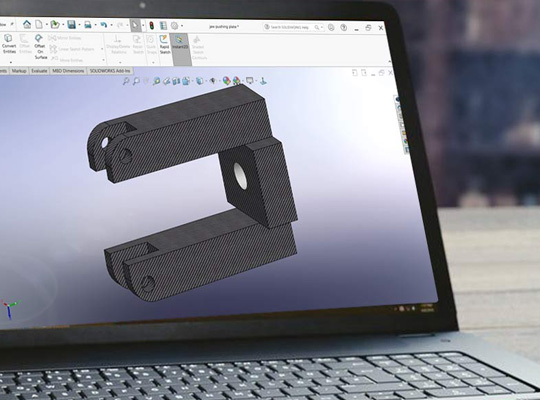
Our design and structural engineering team uses SolidWorks 3D CAD software to develop product geometries, design composite mould tools, and simulate structural performance before any physical tooling is produced. This upfront engineering investment reduces development time, lowers the risk of costly mould modifications, and ensures the finished product meets its structural and dimensional requirements from the first production run.
We support projects at every stage of maturity — from a customer sketch and a performance requirement through to full production-ready tooling and validated composite components. Our engineers have deep knowledge of composite-specific design considerations including fibre orientation, layup sequence, resin system selection, and the interaction between part geometry and the chosen manufacturing process.
Applications:
- Aerospace OEM design
- Custom auto parts
- Medical devices
- Prototype creation
- Composite tooling
- Structural testing